
Hamilton Projected Versus Actual Release
A projected release date is TDCJ's current administrative calculation for a state prisoner. It is not a promise and does not show that the person left a unit. The actual release record is created when custody ends or changes. It can carry a booking-out time, release code, destination, and legal authority. Preserve both labels and the date each source was checked.
Pretrial detention is different. A Hamilton defendant held in Bosque, Lampasas, or another contract jail may be released on bond, remain held, or move to another agency. A bond order supplies legal authority, but processing and other holds can delay the physical exit. The holding jail's event record proves its endpoint. The Hamilton court file explains the order.
Scheduled versus actual: A future date is a calculation. Only the responsible jail or TDCJ release record confirms that the person left custody.
- Projected Release Date
- TDCJ's current calculated date for a state sentence.
- Parole eligibility
- The date or point when a file may be reviewed, not a release promise.
- Maximum expiration
- The sentence endpoint calculation, subject to the governing record.
- Detainer
- A request or hold from another authority that may change where a person goes next.
Find Hamilton Projected Release Dates
Start with custody type. The TDCJ Inmate Information Search applies to a state prison sentence. It does not cover a county-only jail stay. Hamilton defendants may be housed outside Hamilton County, so a local calculation must come from the actual holding jail and the court judgment.
- Ask Hamilton Sheriff which agency physically holds the person and obtain the booking or identification number when available.
- For a TDCJ prisoner, search by TDCJ or SID number. If no number is known, use the name and compare all returned identity details.
- Open the matching state record and preserve the exact Projected Release Date, parole-review fields, location, and query date.
- For county jail time, obtain the Hamilton judgment, jail-credit record, and the holding sheriff's calculation or applied policy.
- For a pretrial case, track bond and court orders, then call the jail for the actual booking-out event and destination.
- Confirm a completed state release through the correct TDCJ post-vote or locator channel, not through the future date alone.
The official TDCJ search screen shows Last Name, First Name, TDCJ Number, SID Number, Gender, and Race. At least one field is required. Its warning also says online data is updated on working days and is at least 24 hours old.
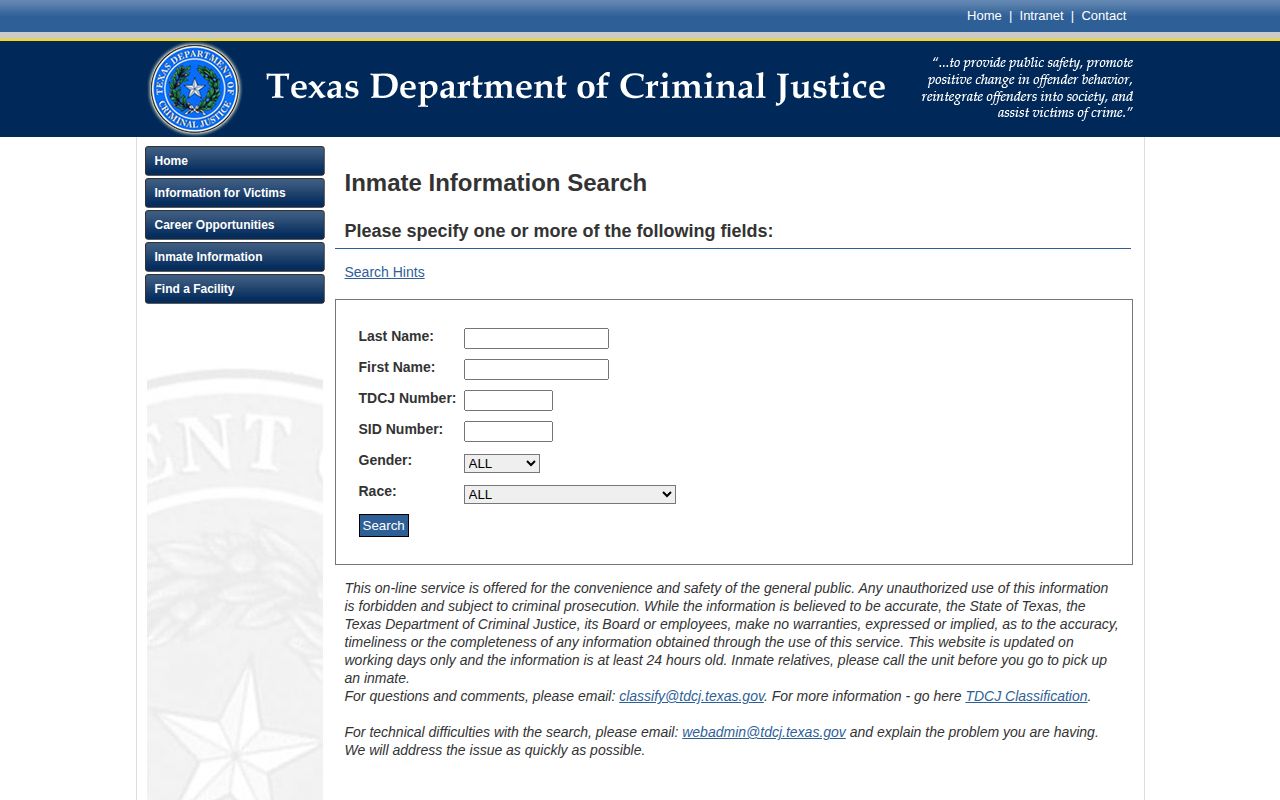
The delay means a unit call or release-status channel can be more current when pickup or an actual departure must be confirmed.
Hamilton TDCJ Date Fields
Several dates can appear in one TDCJ record. They answer distinct questions. Copy the field name rather than shortening all dates to “release date.” A parole-review date concerns consideration. A Projected Release Date reflects a current calculation. Maximum expiration is the sentence endpoint calculation. An actual release or discharge record documents the event after it occurs.
| TDCJ field or status | Meaning |
|---|---|
| Projected Release Date | Current administrative estimate based on the sentence and applicable rules |
| Parole eligibility or review | When consideration may occur or the file's review status |
| Maximum expiration | Calculated sentence endpoint |
| FI decision | Favorable vote that may have a future date or program condition |
| Release or discharge | Recorded state action after custody or supervision changes |
The TDCJ definitions page gives the official date and status terms used in records.
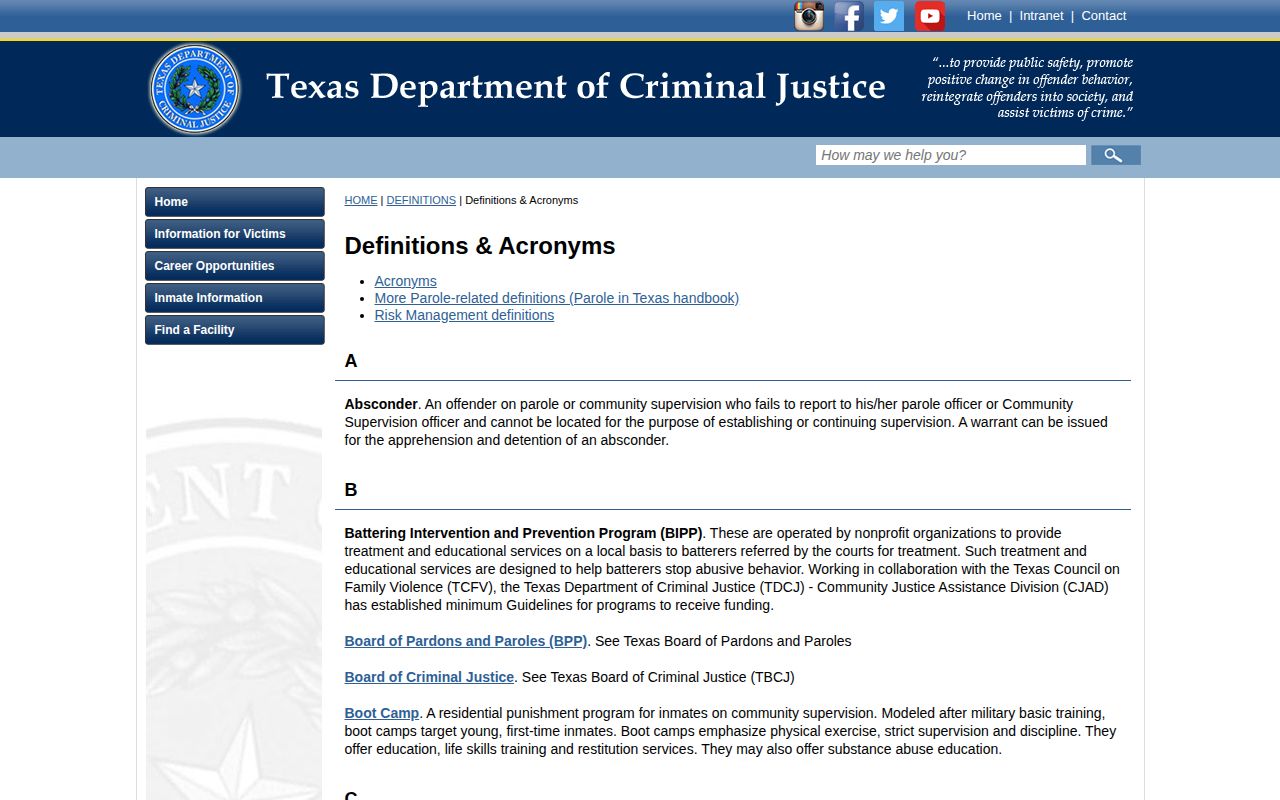
Use the displayed label in any note or records request. Substituting “actual” for “projected” changes the meaning.
Note: A person can leave a county holding jail for TDCJ before the state record appears, so confirm the destination during intake lag.
Hamilton Release Date Fallbacks
If online search fails, TDCJ provides email and telephone access. The no-charge email channel at pia@tdcj.texas.gov can provide the TDCJ number, location, offenses and courts, incarceration history, and Projected Release Date. Supply the full name and seven-digit TDCJ number. If the number is unknown, provide exact date of birth, or approximate age and county of conviction. Name the requested fields.
The TDCJ email-information page defines the projected date and the identifying facts needed for a useful request.
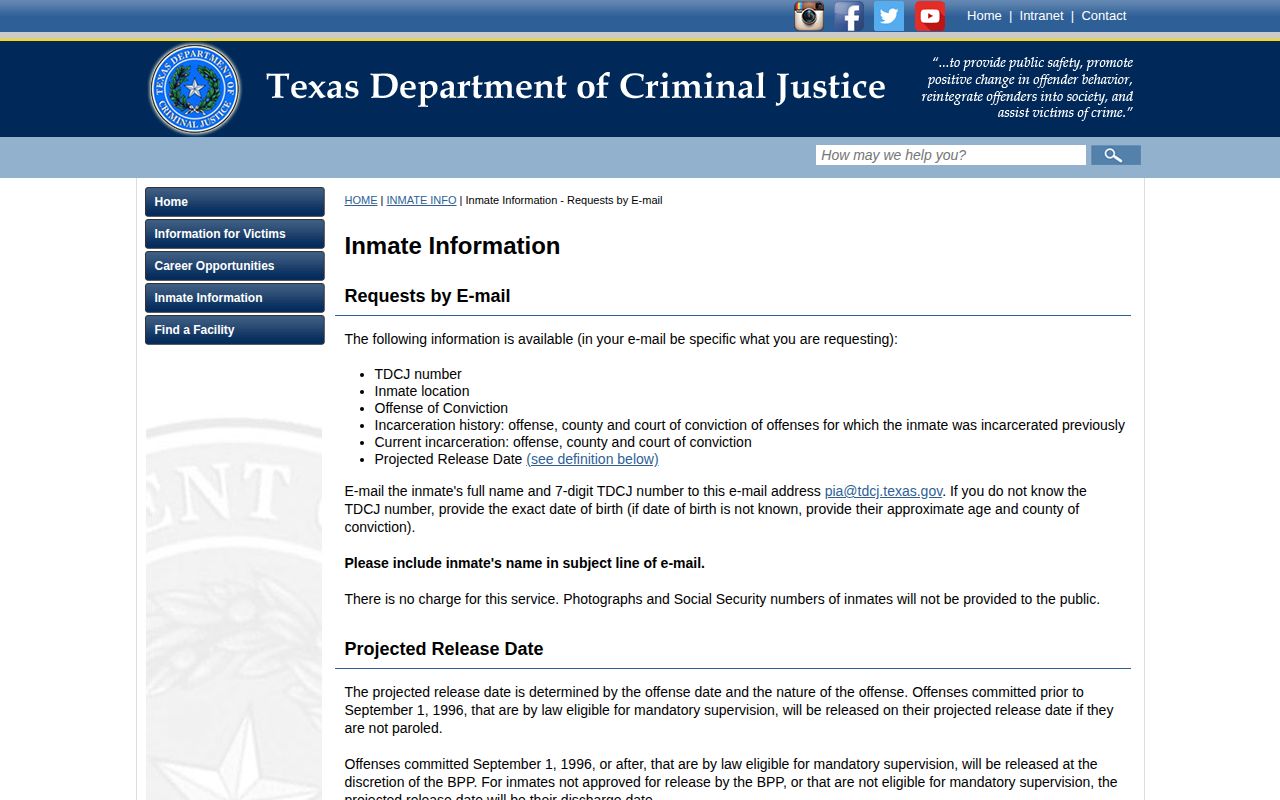
This channel is useful when a former prisoner no longer appears online or a name search fails. It does not provide photographs.
Telephone functions divide the process. Before a Board vote, call 844-512-0461 for parole review status. After a favorable vote, call 512-406-5202 for release processing. The general locator line, 936-295-6371 or 800-535-0283, addresses identity and location. A post-vote check should not be replaced by a projected date.
The complete Hamilton County release-record route adds the local jail register and Hamilton court record when state search alone cannot explain the custody path.
Hamilton Release Credit Rules
Texas good time is governed by Government Code Chapter 498. It can affect classification and eligibility calculations, but it does not simply erase calendar time from every sentence. Good-time credit is not a guarantee of parole. Disciplinary action or classification changes can alter how the record is computed.
Release eligibility and mandatory supervision are governed in part by Government Code Chapter 508. The offense date and law then in effect matter. So do the judgment, offense category, stacked or concurrent sentences, jail credit, findings, and Board action. Some cases use calendar time alone for a threshold. Others may use calendar plus good time. Some are excluded from mandatory supervision.
Texas has no universal 85 percent rule. Applying an “85 percent” shortcut to a Hamilton sentence can create a false date. The current Board eligibility chart is a navigation aid, not a substitute for the statute and judgment. Eligibility only allows review. It does not compel a favorable vote or release.
County jail time uses a separate path. The holding sheriff executes the Hamilton court's sentence, credits, and order. No Hamilton-specific county good-time or weekend-early-release publication was found. Ask for the judgment, jail-credit record, any good-conduct policy actually applied by that custodian, and the final booking-out sheet.
Hamilton Release Dates Can Move
A projected date may change because the inputs or legal status change. The record should be checked again after a disciplinary event, a court ruling, a Board vote, or discovery of another hold. Do not keep an old screenshot as if it were current.
| Change | Possible effect | Best check |
|---|---|---|
| Good-time classification or loss | Recalculates an administrative projection or eligibility | TDCJ record and Chapter 498 |
| Parole vote | May set a future or program-conditioned release path | Board result and post-vote line |
| Mandatory-supervision decision | Can move the field to maximum expiration or later move it earlier | TDCJ definitions and Board record |
| Detainer or other hold | May send the person to another custodian instead of the community | Facility destination field |
| Court order or corrected credit | Can change sentence inputs or release authority | Filed Hamilton order and custodian |
| Data update lag | Leaves an old value visible after an event | Unit or TDCJ telephone channel |
A detainer does not always add time to the displayed sentence. It can change where the person goes next. The releasing facility's destination field is crucial. “Released to agency” should never be described as a return to the community without follow-up.
Hamilton Release Calculation Quirk
A Texas Projected Release Date can move in a way that looks contradictory. When discretionary mandatory supervision is denied, TDCJ may reset the field to maximum expiration. A later favorable decision can move the calculation earlier again. Both entries can have been accurate when observed.
This is the distinctive state rule behind Hamilton date checks. Preserve the observation date, exact label, Board result, and any conditions. Do not turn a changing administrative field into proof of misconduct, error, or completed release. Government Code Chapters 498 and 508, the TDCJ definitions, and the judgment must be read together.
FI vote codes also need their full wording. FI-1, FI-2, and program-conditioned FI results do not all mean the same timing. Approval can remain prospective while a program, eligibility date, or processing step is pending. Use the post-vote release-status line afterward.
Confirm Hamilton Actual Release
For a TDCJ prisoner, confirm a favorable vote through the Parole Division line and later state record. For a county detainee, call the actual Bosque, Lampasas, or other holding jail. Request the booking-out date and time, release code, destination, and authority. Then compare the Hamilton court order.
Texas IVSS-Counties can add a notification layer. The Hamilton County VINELink check explains current IVSS registration and why an alert still needs agency confirmation. Federal and ICE custody use their own locators. A person can leave TDCJ or a county jail and enter another agency's custody.
Past dates need the same care. If TDCJ no longer returns a person, retry with the TDCJ or SID number and use email or telephone access. If Hamilton has no online roster result, request its permanent jail-register entry and the physical custodian's booking-out sheet. A date becomes defensible when its source, label, custody layer, and observation time are all clear.
For a past Hamilton sentence, the filed judgment should be read with the custody record rather than used as a release clock by itself. Jail credit may be stated in the judgment, while the jail applies the order and records departure. A later amended order can change the legal input. Request the version filed at the relevant time and ask the custodian for the record created when release or transfer took place.
Keep calculation notes modest. TDCJ staff and the holding jail apply the legal record; an outside arithmetic estimate cannot account for every classification, credit, hold, or later order. When two official dates differ, compare their labels and observation dates first. One may be an earlier projection and the other a later recalculation rather than a true conflict.
Note: A projected date supports planning, while the official event record supports a claim that release actually occurred.