
TDCJ Release Destinations
Hamilton County's official dockets identify multiple defendants as being in TDCJ. That evidence makes TDCJ a confirmed serving jail for Hamilton matters. It does not establish that every Hamilton detainee goes there or that any placement lasts. Confirm the named person's location with TDCJ offender information and the official TDCJ jail page.
A TDCJ offender-out may show a parole, mandatory supervision, or discharge to the community. It may also show time served, return to Hamilton under a writ, transfer to a different TDCJ unit, commitment to the Texas Department of Criminal Justice, or delivery on a federal or immigration hold. “Released from TDCJ” describes one facility event. It does not by itself say that all custody ended.
Confirm a TDCJ Release
Use a booking number when possible. Names can repeat, and a dated Hamilton docket may become stale after a parole review, classification change, or transfer. TDCJ's current response resolves physical location; TDCJ's historical release processing record resolves the facility endpoint.
- Ask TDCJ offender information whether TDCJ is the current or last TDCJ unit or office.
- Give TDCJ the full name and booking identifier or approximate booking date.
- Ask whether the person remains physically in TDCJ custody.
- If not, request the release processing time, release code, destination, and authority.
- Compare the response to the Hamilton clerk's filed order or docket.
If a parole vote or release calculation predates the release processing time, the records can both be correct. The court supplied authority, while jail staff completed identification, hold, property, and release processing. If another agency appears, continue the custody chain rather than calling the event a community release.
TDCJ Release Record Details
The state custodian maintains the most direct proof of departure. Ask for existing records tied to the exact booking. Avoid asking staff to explain a whole case or compute a result that is not already maintained.
| Record | Use |
|---|---|
| TDCJ offender entry | Preserves identity, intake, confinement reason, and release or transfer date |
| Release-status record | May contain the exact time, code, destination, and processing authority |
| Release authorization | Connects departure to a bond, order, sentence, or agency action |
| Destination field | Separates community release from transfer |
| Code legend | Defines local abbreviations without guesswork |
TDCJ maintains the state offender and incarceration record. Use a public-information request when a former prisoner no longer appears in the online result. A removed web entry is therefore not proof that the underlying record was destroyed.
TDCJ Contact Record
The official sheriff material supplies the jail's address and nonemergency line. TDCJ updates its public search on working days and the data is at least 24 hours old, so a direct inquiry or written public-information request is the documented route.
TDCJStatewide offender information
Texas
936-295-6371 or 800-535-0283
Call before visiting because the research does not provide dedicated records hours. For a written request, identify one TDCJ or SID number, request electronic copies, and ask for a cost estimate. Texas Government Code Chapter 552 governs public information, but exceptions may protect confidential or excluded state record fields. If something is withheld, ask for the cited exception and any Attorney General ruling number.
Chapter 552 calls for prompt production within a reasonable time. It does not promise all records within ten business days. Texas rules require a no-charge offender-information email channel for listed data, which is why a narrow request tied to one TDCJ or SID number is useful.
TDCJ Image and Source Check
The TDCJ Inmate Information Search displays the official state search fields and its update warning.
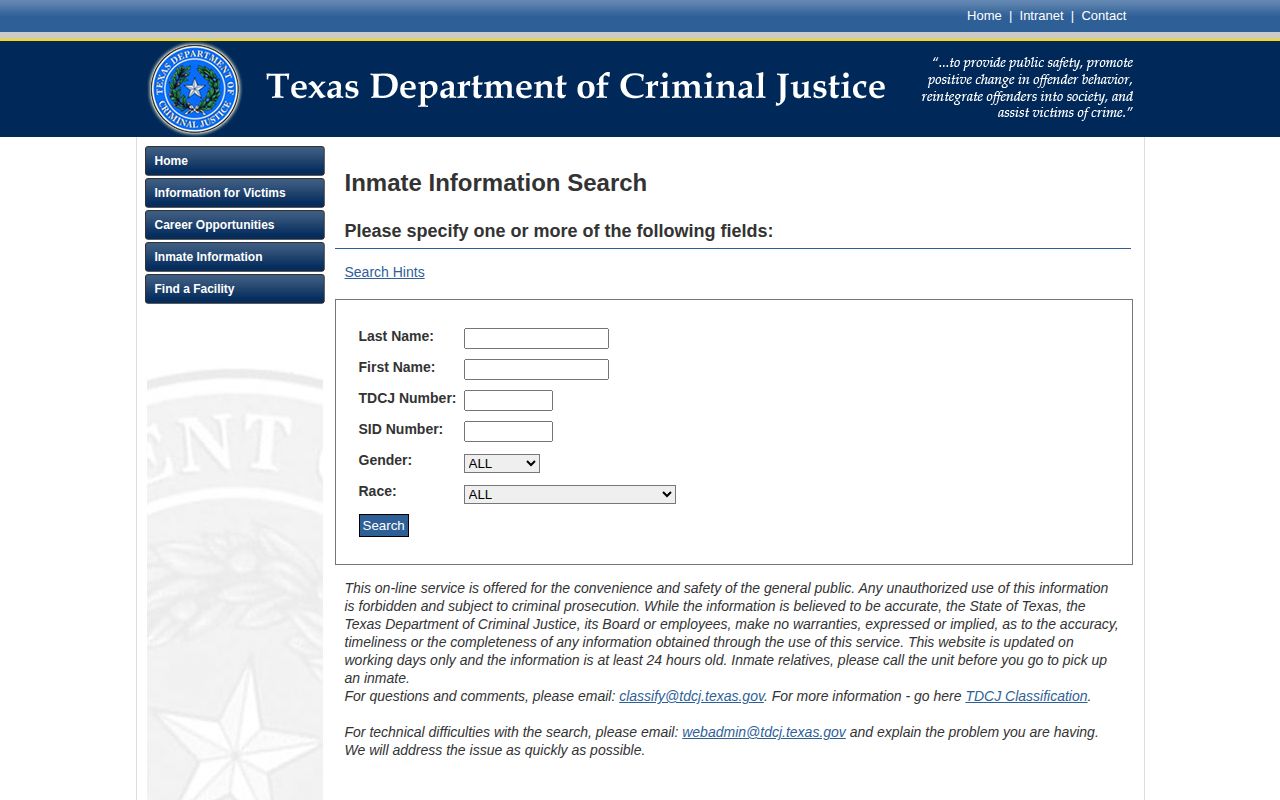
The screen distinguishes the statewide TDCJ route from the county-jail record used for a Hamilton-only release.
TDCJ and Hamilton Records
TDCJ and Hamilton answer different questions. TDCJ establishes the physical release processing event. Hamilton preserves the jurisdictional register, transport trail, and case authority. For misdemeanors, consult the Hamilton County Clerk. Felony filed records belong to the District Clerk. Search by case number first and obtain the actual order rather than relying on a short portal label.
Useful court documents include a parole vote or release calculation, dismissal, judgment, sentence, jail-credit entry, community-supervision order, TDCJ commitment, revocation, or later discharge order. A docket entry points to an event but does not prove the exact minute TDCJ completed release.
Hamilton's permanent jail trail also matters when a live display is gone. Ask Hamilton for the jail-register entry and its transport or transfer documentation. Reconcile full name, birth date, case number, booking number, dates, and destination across both counties.
TDCJ Custody Status Terms
Record the agency's exact wording. Do not translate a local code loosely when its meaning controls whether the person entered the community or another custody system.
- Bond release
- Exit while the Hamilton case continues under stated conditions.
- Writ return
- Movement connected to a court order for temporary production, not necessarily freedom.
- Transfer
- Departure from TDCJ into another custodian's control.
- Time served
- Completion of the identified jail term, subject to other holds.
- Commitment
- Delivery under a sentence, often to the state system after intake.
A person entering TDCJ may disappear from TDCJ before the state search displays an intake result. Allow for system lag, then use the TDCJ number or SID number. A projected state release date is not proof that the person has left prison.
No TDCJ Recent-Release Feed
TDCJ does not publish a Hamilton County recent-release window. Do not infer one from a generic listing or an unofficial service. For “who left today,” ask TDCJ for maintained release processing records within a defined period. For one named Hamilton person, the narrower booking-specific request is more reliable.
The absence of a live entry is negative evidence only. It cannot distinguish bond, transfer, TDCJ commitment, hospital movement, another warrant, escape, or death. The release processing code and destination supply the missing meaning.
Use the Hamilton County release-search path when the TDCJ unit or office is still unknown. That path begins with TDCJ offender information, then follows the actual custodian and court authority.
Note: Preserve the exact TDCJ response and observation date because a current-status answer and a historical release record address different moments.
TDCJ Search Fields and Dates
The TDCJ search accepts Last Name, First Name, TDCJ Number, SID Number, Gender, and Race, with at least one field required. A TDCJ or SID number is the strongest input. Results may show location, offenses, parole-review material, and Projected Release Date. TDCJ updates on working days, and displayed data is at least 24 hours old. Record the observation date and exact label.
For a favorable parole vote, use the post-vote release line at 512-406-5202 to check processing. Before a decision, parole review uses 844-512-0461. Release to parole begins supervision, while discharge can mark the governing end of a sentence. Neither should be confused with a county-only bond release.
TDCJ Release Status Channels
The online search is only one access route. A no-charge request to pia@tdcj.texas.gov may return the TDCJ number, location, offenses with counties and courts, incarceration history, and Projected Release Date when the required identifiers are supplied. It does not provide photographs or Social Security numbers. Telephone access separates the general locator, parole-review status, and post-vote release processing, so call the line that matches the question.
Before a parole decision, the review line addresses the pending file. After a favorable vote, the post-vote line is the better check for physical release processing because an FI decision may set a future date or program condition. Parole ends prison confinement but starts supervised release. Mandatory supervision also places the person in the community under state oversight. Maximum-expiration discharge has a different legal effect and should not be reported as parole.
TDCJ absence is not proof of a Hamilton county-jail release. A person who bonded from Bosque or Lampasas and never entered state prison may have no TDCJ record for that event. Conversely, disappearance from a TDCJ name search can reflect identifiers or database scope. Retry with the TDCJ or SID number, use email or telephone, and compare the Hamilton judgment. The state record, not a projected date or parole vote alone, is the proper proof of a completed state release.